
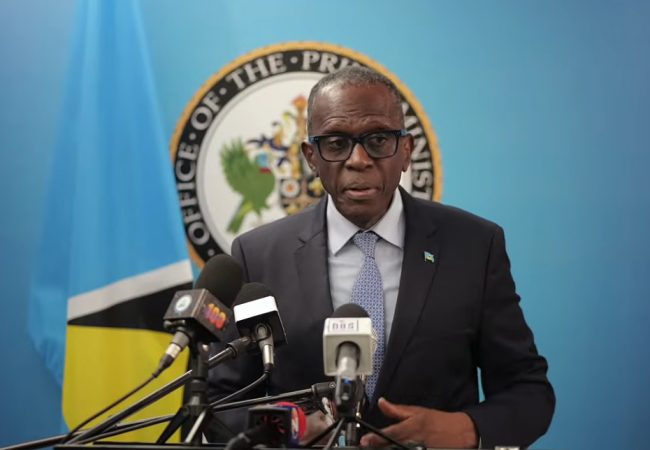
CARICOM chairman defends GSF presence in a “bleeding Haiti”.
CASTRIES, St. Lucia, CMC – Caribbean Community (CARICOM) chairman, Prime Minister Phillip J. Pierre, says “Haiti is bleeding” and is “a sad situation” as he defended the decision of the United Nations Security Council to send foreign troops into the French-speaking CARICOM country.
Pierre, also the prime minister of St. Lucia, told the weekly cabinet news conference that he raised the issue of Haiti during last week’s United States-Caribbean Dialogue with United States Deputy Secretary of State Christopher Landau.
“Haiti is a very sad situation. I raised it with the US, even if it was not part of the agenda. I raised Haiti with the US. Haiti is a very sad situation. Now they may have to postpone the elections, which are supposed to be held in December. But Haiti is bleeding. Haiti is a sad situation,” Pierre told reporters.
The United Nations Security Council was told on Monday that armed groups in Haiti are adapting to intensified security operations, stepping up reprisals against civilians and extending their reach into rural areas.
Monday’s briefing came two weeks after presidential and legislative elections planned for December 13 were postponed indefinitely, with the UN’s top official in the country cautioning against setting new dates without a realistic assessment of whether a vote can be held.
Haiti has not held national elections since 2016, and Carlos Ruiz Massieu, the UN’s top official in Haiti, said nevertheless that preparations are ongoing.
He said more than 35 political parties and groups and 3,500 candidates have registered, and as of October 5, only 759,257 potential voters were on the lists, out of an estimated electorate of 6.5 million people.
Insecurity and mass displacement are further complicating election organization.
“Setting new dates for elections without a realistic assessment of their feasibility will only erode public confidence and the credibility of Haitian institutions,” he warned
The Security Council was also informed that the authorized Gang Suppression Force (GSF) is not yet fully deployed and that security forces are intensifying their operations, but the gangs are not giving up.
Pierre told reporters that Haiti is part of the Caribbean history as well as “part of our hemisphere.
“Haiti is bleeding. So it’s not a matter of supporting foreign intervention,” he said with reference to the GSF, the UN-authorized multinational security and military mission deployed to combat armed gangs, protect critical infrastructure, and support local forces.
It replaced the earlier Multinational Security Support Mission (MSS), and its mandate has been extended through March 31, 2027. So far, despite an initial call for a deployment of 5,500 troops, between 1,500 and 2,000 troops have been actively deployed from contributing countries Chad, Jamaica, Guatemala, and El Salvador.
The Guatemalan military has since announced the deployment of a new military contingent to Haiti. In a statement posted on its official Facebook page, the Guatemalan military said it held a departure ceremony for a contingent from the 2nd Military Police Unit and that the group will join the GSF.
According to a statement, the ceremony took place on the tarmac of a Guatemalan airbase. Major General Henry David Saenz Ramos, Guatemala’s Minister of National Defense, presided over it.
Pierre has dismissed suggestions that the GSF is an invasion force. Saying, “It’s a matter of trying to see if you can alleviate the hardship in Haiti.
“CARICOM has decided that a Gang Suppression Force is one of the ways you can help to halt the bleeding that’s taking place in Haiti.
“So CARICOM has agreed, and then there’s not been any other initiative that’s happened to cause us to believe that the gang suppression force is not right, is not a right move. But the concern about Haiti is overwhelming, and the situation in Haiti seems to be getting from bad to worse,” Pierre added.
Meanwhile, the Haitian authorities have announced a state of emergency (SoE) until December 18 in the departments of West, Artibonite and Center to combat insecurity.
The government is calling on the entire population to remain calm, saying it is fully aware of the need to support citizens amid measures that could seem contrary to the public interest.

 and then