PORT OF SPAIN, Trinidad, CMC – The Trinidad and Tobago government says it has approved a production sharing contract for two offshore blocks with the state-owned China National Offshore Oil Corporation (CNOOC).
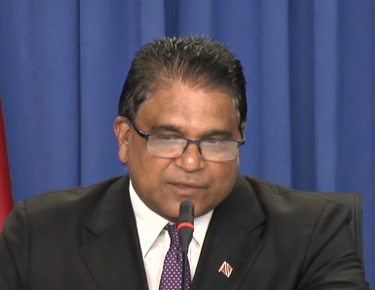
Energy and Energy Industries Minister, Dr. Roodal Moonilal, told the weekly post-cabinet news conference on Thursday evening that Cabinet had accepted a recommendation from his ministry to move forward with the award of Blocks 24 and 25 to the Chinese state-owned company following a competitive bid round conducted last year.
He brushed aside suggestions that Port of Spain, while publicly condemning the lack of democratic rule in Cuba, is comfortable doing business with Communist China.
“…you’re inviting me to jump out of my crease and swing down the wicket. And when you do that, you take the risk of being completely bowled. So these are matters of politics that you raise, of course, have to do with international relations and so on. It is not my domain.
“All I can indicate is that via our competitive bid rounds, the Chinese company did participate, satisfy those initial preliminary requirements, and we have approved two blocks for the company.”
Moonilal told reporters that CNOOC is a global company that operates all over the Western world and not just in China, “and with investments around the globe … we continue to do business with them”.
Moonilal insisted that his main concern now is to complete negotiations and arrive at a production-sharing contract that we could sign off on and proceed with further exploration.
“As we said from the beginning, our motto is keep it pumping. We need exploration and production. In fact, the failure of this country over the last period, 2016 to April 2025, was this dramatic decline in exploration and production.
“We are addressing that now with ExxonMobil, with CNOOC, and with others. We have had very strong interest from other oil majors. That is my concern, and that is the government’s concern at this moment,” Moonilal told reporters.
Moonilal said that the offshore acreage lies roughly 45 to 50 miles off Trinidad’s north coast.
“We had a very strong interest by a company, a very important company, China National Offshore Oil Corporation,” he added.
Moonilal also confirmed progress on a key cross-border gas initiative involving Shell and the Venezuelan government. He said Shell signed a framework agreement with Venezuela, which establishes the structure for advancing the Dragon gas project. The agreement is expected to provide the company with the regulatory and commercial certainty needed to proceed with development.
He told reporters that the government now has a clearer timeline for the project, with first gas expected between the second and third quarters of 2027, if current schedules remain on track.
He said that Dragon forms part of a broader set of cross-border energy projects being pursued to secure additional gas supply. These include the Cocuina-Manakin and Loran-Manatee fields.
But he said that the Trinidad and Tobago strategy is not solely dependent on cross-border gas development.
“But the coast is clear for the full exploration of production at the Loran-Manatee field, at Cocuina-Manakin, and at Dragon,” Moonilal said, adding, “But I want to make the point for the citizens to understand that we are not depending on cross-border gas alone. We have what could be about 11 other projects that we are working on, almost daily”.
During the news conference, Moonilal also addressed the potential financial impact of rising global oil prices driven by geopolitical tensions in the Middle East, particularly involving Iran.
He said that while higher crude prices could generate additional revenue for the country, the financial benefits would likely be modest, and that based on current estimates, an increase in Brent crude prices from approximately US$72 per barrel to around US$85 could yield about US$10 million in additional monthly revenue.
But Moonilal said that higher global prices could also drive up the government’s fuel import bill.
 and then