
































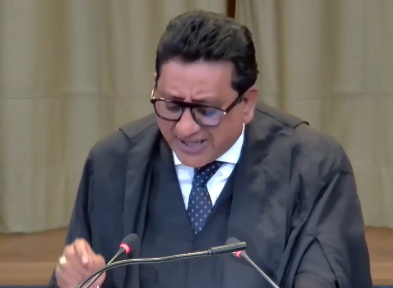
HAGUE, CMC – Guyana Friday reiterated its position that the disputed Essequibo Region is part of its territory and dismissed the positions outlined by Venezuela before the International Court of Justice (ICJ) as unbelievable.
Attorney General and Minister of Legal Affairs, Anil Nandlall, delivering Guyana’s final oral presentation before the ICJ panel, said it is difficult to put into words how important this case is to Guyana and its people.
“As the court knows, this hearing is the culmination of a process that has been decades in the making. For more than 60 years, Venezuela has laid claim to more than 70 percent of Guyana’s sovereign territory.”
Nandlall said generations of Guyanese have grown up under the “long and threatening shadow” caused by Venezuela’s claim to nearly three-quarters of his country.
“Venezuela’s claim has blighted, bedeviled, and burdened Guyana for the entirety of its life as a sovereign state. It is hard to overstate the impact that this has had on Guyana, Guyana’s development, and on the security, prosperity, and well-being of its people.”
Nandlall said that the loss of the territory claimed by Venezuela would eviscerate Guyana. Indeed, “the country as we know it would cease to exist,” he said, adding that his delegation was not exaggerating when it described this case as” having an existential quality for Guyana. “For Guyana and its people, the stakes could scarcely be higher. But while the stakes of this dispute could not be higher, nor could Guyana’s faith in international law as the means for fairly and finally resolving it.”
He said he can personally attest to Guyana’s profound commitment to the rule of international law, saying “it is a commitment which runs deep in Guyana’s institutions and national culture.
“It is both an article of faith and a source of national pride. It is founded on a firm conviction that international law is the bedrock of the international order and the indispensable foundation for peaceful relations between all states.
“From Guyana’s perspective, there is no higher value or greater imperative than respect for international law,” Nandlall said, noting that when Guyana brought its application to the court in 2018, it was confident of three things.
“First, Guyana had unwavering confidence in the correctness of its decision regarding the validity of the 1899 award and the boundary which it determined. Second, Guyana was equally confident in the Secretary-General of the United Nations’ decision to entrust the court with resolving this intractable controversy.
“Third, Guyana had complete confidence in the independence and impartiality of the court and its ability to deliver a just outcome based on the fair-minded and even-handed application of international law.
Nandlall said that since Guyana filed its application eight years ago, these proceedings have vindicated and reinforced its confidence in each of those things and that “at every stage, the court has conducted the proceedings with conspicuous care, attentiveness, and fairness.
“The court has carefully considered and confirmed its jurisdiction to entertain Guyana’s application, and it has carefully considered and confirmed the admissibility of that application.
“We have no doubt that the court will now proceed to carefully consider the merits of Guyana’s case regarding the validity of the 1899 award and the location of the parties’ land boundary.”
Nandlall said that since the start of the proceedings, Venezuela has strained every sinew to avoid the court delivering a judgment on the merits of Guyana’s application. He said these tenuous efforts have even continued throughout this hearing on the merits.
“Notwithstanding this court’s judgement in 2020 and 2023, Venezuela has sought to argue that the terms of the Geneva agreement mean that the court cannot or should not rule upon the of the 1899 award,” Nandlall said, adding that Guyana’s counsel have demonstrated the lack of merit in those arguments, which find no support in the text or the history of the Geneva agreement, and which are contradicted by Venezuela’s previous statements to the court and so clearly by the pellucid terms of the court’s previous judgments on jurisdiction and admissibility.
“It is not hard to see why Venezuela is so reluctant for the court to determine the merits of Guyana’s application. Venezuela knows that it has no good answer to Guyana’s case, and it knows that a judgment on the merits should bring to an end Venezuela’s claims to almost 160,000 square kilometers of territory.”
Nandlall said in its written and oral pleadings, Guyana has “convincingly” demonstrated that Venezuela’s attempt to impugn the validity of the 1897 Treaty of Washington has no merit whatsoever.
“Venezuela was neither deceived nor coerced into signing the treaty. On the contrary, the treaty achieved what Venezuela had long desired and demanded: the submission of its boundary dispute with Great Britain to international arbitration.
“Guyana has similarly and axiomatically demonstrated that Venezuela’s attack on the validity of the 1899 award itself is misconceived. Neither the absence of written reasons nor the timing of the award’s delivery calls into question its validity.”
The Guyana Attorney General said that the arbitral tribunal faithfully fulfilled the mandate conferred by the 1897 Treaty.
Neither the terms of the award nor the way it was reached involved any excess of power or impropriety by the eminent members of the tribunal. What is more, Guyana has shown that when the award was delivered in 1899, Venezuela was aware of all the matters which it now alleges vitiated the award.
“Yet for more than 60 years after 1899, Venezuela respected, asserted and affirmed the validity of the award,” he said, adding, “in short, the award was and remains valid and binding on the parties. In the words of the 1897 Treaty, the award constitutes the full, perfect, and final settlement of the boundary between Venezuela and Guyana.”
Nandlall said he was also taken aback by Venezuela’s attempt to invoke the law of decolonization to support its case, saying it “is legally unfounded.
“But it is also ironic because Venezuela’s sudden repudiation of the 1899 award in the 1960s, just as the process of Guyana’s decolonization was underway, impeded and delayed Guyana’s progress towards independence by several years.
“And in the years since Guyana attained independence in 1966, Venezuela has acted in a way that has striking echoes of the imperial colonialists whom it rightly denounces. As Guyana has explained, both in its written and oral pleadings, since 1966, Venezuela has repeatedly denied and violated Guyana’s sovereignty over its Essequibo region.”
Earlier, International Law Professor Alain Pellet said the 1899 Arbitral Tribunal’s award of the land boundary between Guyana and Venezuela was delivered unanimously, despite Venezuela’s claim that the tribunal president, Friedrich Martens, made efforts to reach consensus.
“An 1899 award admittedly failed to state reasons, but with a slight exception, the arbitrators unanimously signed a text indicating that they had faithfully adhered to the text…of which is reproduced verbatim in the award,” Pelet said.
He said that Venezuela’s position that the 1899 tribunal did not provide any reasons for its decision was wrong, noting that at that time, such a statement was not yet mandatory, even though it might have been desirable.
Pelet quoted in part the text as saying that the panel “investigated and ascertained the extent of the territories belonging to or that might lawfully be claimed by the United Netherlands or by the Kingdom of Spain, respectively, at the time of the acquisition by Great Britain of the colony of British Guiana”.
Venezuela, this week, presented to the ICJ excerpts of documentary evidence it said proved that there was collusion by Martens and members of the tribunal that ultimately arrived at a settlement to the advantage of the United Kingdom, then the colonial power of British Guiana.
But another of Guyana’s agents, Professor Philippe Sands, said Venezuela accepted the 1899 Award for more than 60 years, fully aware that the boundary was settled by consensus, which, until today, remains a “constant feature of arbitral deliberation”.
He described Martins’s striving for consensus as an “act of decency and wisdom”, suggesting that if the arbitrators had failed to agree, it would have confirmed Great Britain in the possession of even more territory, and that was what Martins wished to avoid.
Sands said Venezuela, instead, relied on the Mallet-Prevost memorandum as a means of reviving anti-colonial sentiment.
Professor Nilüfer Oral, also arguing for Guyana at the ICJ’s oral hearings, said the evidence shows that Britain remained loyal to the 1899 boundary and never attempted to or threatened to cross or expand it.
“The award accomplished Venezuela’s objective in seeking arbitration. It halted the westward advance of British settlement permanently.”









 and then
  as unbelievable)