




























WASHINGTON, CMC – The Organization of American States (OAS) Tuesday said it is prepared to play a meaningful role in the future development of Venezuela as member countries split over whether the United States’ decision to invade the South American country last Saturday, seizing its head of state, upholds accountability or undermines a foundational principle of international order.
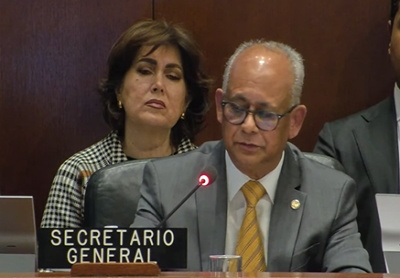
OAS Secretary General, Albert Ramdin, told a special meeting of the OAS Permanent Council following the US military action that led to the seizure of Venezuelan President Nicolas Maduro and his wife, that there is need to “reaffirm the importance of unity within the American region, recognising that diversity of views exist by underscoring the shared responsibility to peace and stability in the hemisphere”.
Ramdin said member states are the cornerstone of that unity, and as the “shared adherence to international law in the Inter-American legal framework which provides a common point of reference for dialogue and collective consideration, including respect for sovereignty, human rights, and democratic governance.
‘As we go forward, we must consider in what way we all can find the moment to reaffirm the collective commitment of member states to these norms and values that underpin our unity and peaceful coexistence in our hemisphere.
Ramdin said that the Americas have historically aspired to be a zone of peace and that safeguarding this position “continues to be in the collective interest of all member states.
He said with regards to Venezuela, the “commitment is clear,” and that morally, the member states owe the Venezuelan people “our solidarity.
‘Strategically, a stable democratic and prosperous Venezuela is in the interest of every single member state around this table. At a minimum, we share responsibility for finding solutions that deliver concrete improvements to people’s lives, while respecting the inalienable right of the Venezuelan people to determine their own government and leadership in a representative democracy.
Ramdin said that the OAS also welcomes the willingness of several member states, as stated today, to cooperate in good faith and in diverse ways “during this particular sensitive period”.
He said that the strength of the Inter-American system lies not in uniformity of views, but in member states’ capacity to engage constructively despite ideological differences.
“Therefore, we encourage member states to continue using this forum to listen to one another, seek areas for convergence, and avoid actions that could deepen divisions or heighten tensions.
“We must also reaffirm that maintaining the Americas as a hemisphere of peace is a shared achievement and a shared responsibility requiring cooperation, prudence, and sustained management and engagement.
The OAS Secretary General said that following private meetings on Monday and requests regarding the role of the OAS Secretariat in restoring democracy, the hemispheric body, based on its responsibilities, mandate, and charter, “is here to safeguard democracy, defend human rights, promote development and stability, and strengthen multi-dimensional security to keep our hemisphere a zone of peace.
“The stability of our region depends on our collective response. A stable democratic Venezuela is good for its people and good for the whole hemisphere,” he said, reiterating that the OAS will be a key venue for dialogue, reflective and collective engagement consistent with its mandate.
“We must highlight the potential value of the OAS as an honest broker,” Ramdin said, adding that the body acts as “a trusted partner to our members…fully respecting the principles of sovereignty, non-intervention and constitutional order”.
But he said that the OAS would continue to monitor and document the human rights situation in Venezuela with particular attention to political prisoners.
“We are convinced that Venezuela’s path must be grounded in the will of its people,” he said, noting that “sustainable stability and democratic legitimacy can only be achieved through peaceful means.”
But he acknowledged that recent reports, “on top of all that we already knew are giving us reasons to be concerned. Repression and political prosecution must not be tolerated in Venezuela or anywhere else in our hemisphere.
Ramdin ended his presentation by recalling the words of Simon Bolivar, given more than 200 years ago, that “each nation may govern itself according to its character and circumstances, but all require order, justice, and cooperation if freedom is to endure. Without unity of purpose and adherence to common principles, no republic can hope to achieve stability, much less peace.
Earlier, the 15-member regional integration grouping, CARICOM, in a statement read out by the Jamaica delegation, reiterated a call for “peaceful dialogue” to ensure stability in Venezuela.
“The region reiterates its call for peaceful dialogue through diplomatic channels to ensure Venezuela’s stability, good governance, democracy, and prosperity for the people of Venezuela,” the diplomat said, adding that “CARICOM remains ready to support all such efforts, in a spirit of cooperation and mutual respect.”
The Jamaican delegate said that the regional grouping “assures that every effort is being taken to ensure the safety and security of citizens of the Region” and that it “will continue to monitor the multifaceted impact of this evolving situation and the implications for economic activity within the Community, particularly air travel.
The United States delegate, in his address, was disrupted by a woman protestor, who told the OAS Special sitting that Washington wanted to uphold peace and democracy across the hemisphere.
“Let me be clear, the United States did not invade Venezuela. This was a targeted law enforcement action that resulted in the arrest of an indicted criminal and co-conspirators to bring them to face American justice,” he said, urging the member states to read the indictments against the Maduros.
“This action was not taken lightly,” he said, noting that President Trump in the past offered President Maduro “several opportunities” to resolve the matter, which he refused.
“This is not about democracy, this is not about human rights. We want a better future for Venezuela and its democratic future,” he said, calling for the immediate release of all political prisoners, which Washington estimates to be at least 1,000.
He said the United States was not going to allow Venezuela to be turned into an “operating hub” for Iran, Russia, Cuba, China, among others.
“You cannot continue to have the largest reserves of oil in the world under the control of the adversaries of the Western Hemisphere while the people of Venezuela have no electricity, a substandard quality of life, and its profits don’t benefit the people of Venezuela,” the US diplomat told the OAS.









 and then
  Tuesday said it is prepared to play a meaningful role in the future development of Venezuela as member countries split over whether the United States' decision)