















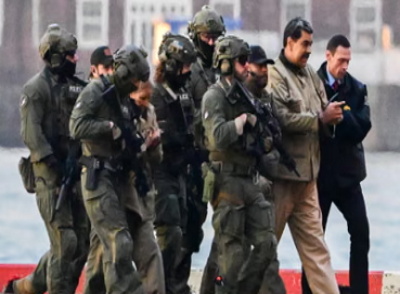
NEW YORK, CMC -A defiant Nicolas Maduro, Monday, pleaded not guilty to drug trafficking and other charges, telling a New York Federal Court that “I am still president”.
Maduro and his wife, Cilia Flores, were seized from their Caracas compound last Saturday and flown to the US as part of a special forces operation that has drawn both praise and condemnation from around the world.
The United Nations Security Council is meeting in an emergency session. When he appeared in court, Maduro told the 92-year-old judge in Spanish, “I was captured at my home in Caracas, Venezuela.”
Maduro, wearing a blue jail uniform, and his wife were led into court for a brief, but required, legal proceeding that will likely kick off a prolonged legal fight over whether he can be put on trial in the U.S. Both put on headsets to hear the English-language proceeding as it is translated into Spanish.
The couple was transported under armed guard early Monday from the Brooklyn jail, where they’ve been detained, to a Manhattan courthouse.
The matter has been adjourned to March 17.
As a criminal defendant in the US legal system, Maduro will have the same rights as any other person accused of a crime, including the right to a trial by a jury of regular New Yorkers.
Maduro’s lawyers are expected to contest the legality of his arrest, arguing that he is immune from prosecution as a sovereign head of state.
Panamanian strongman Manuel Noriega unsuccessfully tried the same defence after the US captured him in a similar military invasion in 1990. But the US doesn’t recognize Maduro as Venezuela’s legitimate head of state, particularly after a much-disputed 2024 re-election.
Venezuela’s new interim president, Delcy Rodriquez, has demanded that the United States return Maduro. Before his capture, Maduro and his allies claimed Washington’s hostility was motivated by lust for Venezuela’s rich oil and mineral resources.
Trump suggested Sunday that he wants to extend American power further in the Western Hemisphere and that removing Maduro would enable more oil to flow out of Venezuela.
The 25-page indictment made public Saturday accuses Maduro and others of working with drug cartels to facilitate the shipment of thousands of tons of cocaine into the US. They could face life in prison if convicted.
At the UN Security Council meeting, UN Secretary General, Antonio Guterres, said the session was taking place “in a grave time” and that the extent of casualties resulting from the US military action in Caracas “remains undetermined.
Guterres said that President Trump has indicated that Washington will run the country until such time that it can do a safe, proper, and judicious transition.”
But he said, “What is less confident is the immediate future of Venezuela.
“I am deeply concerned about the possible intensification of instability in the country, the potential impact on the region, and the precedent it may set for how relations between and among states are conducted.
“The situation in Venezuela has been a matter of regional and international concern for many years now. Attention on the country only grew following the contested presidential elections in July 2024.”
The UN Secretary-General said that the panel of electoral experts he appointed at the Venezuelan government’s request to accompany the elections highlighted serious issues.
“We have consistently called for full transparency and the complete publication of the results of the elections. As we reported to the Council on 23 December, the Office of the High Commissioner for Human Rights has catalogued serious violations.”
But Guterres said that he remains “deeply concerned that rules of international law have not been respected about the 3 January military action.
“The Charter enshrines the prohibition of the threat or use of force against the territorial integrity or political independence of any state. The maintenance of international peace and security depends on the continued commitment of all Member States to adhere to all the provisions of the Charter.”
He said that the situation in Venezuela is critical, but it is still possible to prevent a broader and more destructive conflagration.
“I call on all Venezuelan actors to engage in an inclusive, democratic dialogue in which all sectors of society can determine their future. This entails the full respect of human rights, the rule of law, and the sovereign will of the Venezuelan people.
“I also urge Venezuela’s neighbours, and the international community more broadly, to act in a spirit of solidarity and in adherence to the principles, laws and rules erected to promote peaceful coexistence,” Guterres added.






 and then