








































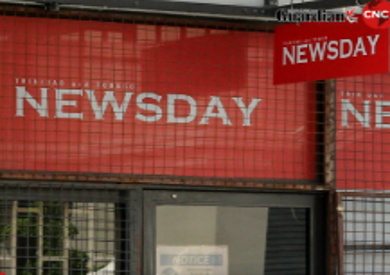
PORT OF SPAIN, Trinidad, CMC – Thirty-two years after it began operations as the country’s third daily newspaper, Newsday announced on Saturday that it had commenced legal proceedings to wind up its business.
A public notice published in all daily newspapers states that a petition to wind up Daily News Ltd, publishers of Newsday, was filed on December 31, 2025, and the first hearing is set for January 19.
The company’s managing director, Grant Taylor, said in a statement that “a perfect storm of challenges has led to where we are now: closure.”
Newsday was established in 1993 by a group of journalists led by the late Therese Mills, and it challenged the two other established daily newspapers, the Trinidad Express and the Trinidad Guardian, both of which were part of conglomerates.
In announcing the newspaper’s closure, Taylor said it “is no different in most respects from the other players in the market,” adding, “ this is an industry under severe pressure.
“But one crucial difference is that, as a stand-alone entity which is not part of a media conglomerate, there is nowhere for Newsday to hide the year-on-year losses all the local daily newspapers are suffering.
“Whilst the scourge of COVID is undoubtedly a factor, as the country shut down more than once, and with it, advertising sales fell off dramatically, that was by no means the only nail in the coffin.
“The elements of this perfect storm are as varied as they are damaging, with no single factor exclusively to blame. This is also not a ‘this just suddenly happened’ scenario, but rather, a symphony of events playing out over a decade.”
Taylor acknowledged that the challenge is not unique to Trinidad and Tobago, as globally, traditional print media have been under pressure for some time.
He said thousands of newspapers have closed worldwide. In the United States alone, more than 3,500 are estimated to have closed in the last 20 years, adding “some challenges have been causes of our demise; others have hastened it.
The Newsday official said that the cost of raw materials, and in particular paper, the most significant expense, has also skyrocketed in the last decade and that the cost of machinery and of maintaining it has also increased significantly, as manufacturers of the main components have gone out of business owing to the industry’s contraction.
“The world has also changed, and Trinidad and Tobago is no different. The value placed on traditional media has diminished, and the political campaign to discredit them for nefarious reasons has ramped up.
He said when Newsday’s price increased by one dollar (One TT dollar=US$0.16 cents) a year ago, 40 per cent of the readership said, “No, thank you,” noting that the three-dollar price for a copy of the newspaper is less than the price of one of the country’s best-known delicacies.
“A newspaper entails hundreds of people working every day of the year, and working around the clock, to keep the public informed, but three dollars is too much to ask for that service. Advertising revenue has also decreased significantly over the last decade.
“Advertising in all media is a fraction of what it was then, but for print media, that drop has been most severe. Print advertising has fallen by 75 per cent. In the context of the significant increase in costs, this is the most impactful element of the perfect storm that has been brewing over the last decade.”
Taylor said that even as the newspaper becomes “another statistic in the casualties on the print media landscape, we remain proud of our legacy of unwavering independence in keeping the public informed.
“We are grateful to those who supported Newsday throughout, to longtime readers and those who discovered and came to appreciate the paper’s strengths more recently.
“We are grateful, too, to the dedicated staff of every department who worked every day and night for over two decades, determined that the paper must come out, in the interest of that readership.”
Taylor said he is encouraging people here to continue supporting the local media industry, adding, “The media are one of the most important elements in any democracy, and it is a telling sign of a democracy itself under threat when the media are under threat.”
Taylor said the industrial-relations climate has always been particularly challenging, from trying to get all interested parties on the same page to rulings that sometimes appeared to discount the financial reality of many companies to the detriment of the organisation and all employees.
“It would be remiss, however, not to mention that the courts seem to have changed their approach in more recent times. The cost, however, is in the millions and is a challenge for a small company,” he added.











 and then