


























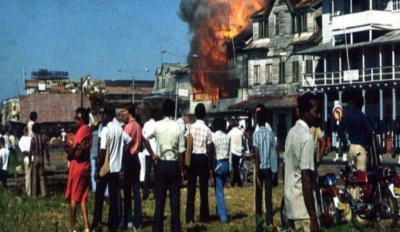
PARAMARIBO, Suriname, CMC – A former senior government minister is urging local historians to independently research and document the successful coup d’état by Sergeant Major Desi Bouterse on February 25, 1980, after dismissing as “an investigation fir for the trash” an investigation conducted by the authorities in The Hague.
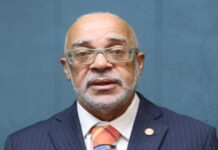
“A people that doesn’t know its true history is doomed to repeat it,” former planning and development cooperation and defence minister, Ronald Assen, told the De Ware Tijd newspaper.
Assen, who served in cabinet from 1993-1996 and again from 2000-2005, has also labelled the Hague investigation report that concludes that the Dutch military mission in Suriname was not involved in the successful coup d’état as a “serious attempt at historical falsification” and “historical fraud”.
Late last month, the De Ware Tijd newspaper published the main findings of the Dutch investigation, concluding that there were no indications that Dutch Colonel Hans Valk or other Dutch military personnel participated in the preparation or execution of the coup.
According to the report, Valk, who was the military attaché in Paramaribo at the time, was unaware that the coup was about to take place. However, it was acknowledged that the Netherlands made mistakes in oversight and information management.
Bouterse led a military coup in Suriname on February 25, 1980, overthrowing the elected government of Henk Arron, an event known as the Sergeants’ Coup, establishing a military dictatorship that lasted until 1991, marked by human rights abuses, corruption, and executions, including the infamous December Murders of 1982.
Bouterse became the de facto ruler, consolidating power despite initial promises of democracy, prompting international pressure and eventually leading to a return to civilian rule. However, he remained a significant political force.
He returned after another coup in 1990 and was in power for a year. In 2010, Bourse was elected president of Suriname and governed for a decade. In 2023, Bouterse was sentenced to 20 years in prison for the 1982 execution of political opponents, including lawyers, journalists, business people, and military prisoners.
Bouterse died on December 23, 2024, at the age of 79, a fugitive from justice.
According to Assen, the report, which was apparently completed as early as 1984, is completely unreliable, pointing out that Colonel Valk himself provided extensive information to the weekly magazine Vrij Nederland as early as December 1982, shortly after the traumatic December Murders.
The former government minister also refers to other news reports regarding the coup, adding that the authors of the Hague report “should be deeply ashamed,” calling the document “a piece of junk that belongs shredded and thrown in the trash.
Assen said that the investigation focused too narrowly on archives and diplomatic documents, arguing that this is a fundamental limitation, as senior Dutch military personnel would naturally not leave “easy traces” in official documents during sensitive operations. He also points out that the report itself demonstrates that precisely those archives and documents on which the investigation is based are unreliable in several respects.
For example, internal reports from the Army Intelligence Service were partially lost or forwarded only incompletely. Furthermore, passages from documents were deleted before they arrived in The Hague, and the diplomatic messages from Paramaribo subsequently proved to be incomplete.
According to Assen, this form of archival manipulation is understandable from a Dutch perspective, given that the country’s international reputation was at stake, following reports that the Netherlands allegedly collaborated in a coup against a legally elected government within five years of Suriname’s independence in 1975.
In his argument, Assen also mentions several facts and circumstances that, according to him, are missing from the Dutch report, but are nevertheless crucial for understanding the context in which the coup took place.
For example, he points to an economic stalemate within the Netherlands/Suriname Development Cooperation Committee (Cons), where considerable tensions prevailed. Suriname wanted to invest in large-scale projects, such as the West Suriname project, while the Netherlands considered these plans a waste of taxpayer money.
Assen also alleges that Surinamese authority was undermined. Dutch Cons members allegedly made subversive statements about projects, addressed to or about then-Prime Minister Henk Sneevliet, outside of official meetings.
Assen also cites direct evidence of suspicious behaviour within the Dutch military mission, giving as an example, “Colonel Valk had staff members; I don’t know how many. One of them instructed his secretary—the daughter of a member of parliament who died in 1979—how to act the next morning if she heard shots one night>
“Another staff member was married to a Surinamese woman. Children of this family still remember, as if it were yesterday, the camouflaged faces of Surinamese soldiers visiting their father.”
According to Assen, this points to unusual and disturbing contacts, adding that it’s not uncommon for national coup plotters to remain silent about external aid.






 and then