

































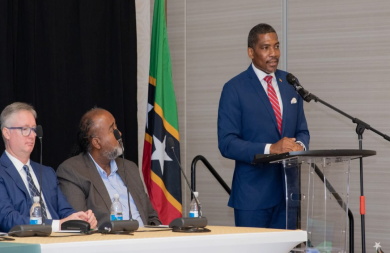
BASSETERRE, St. Kitts, CMC – The St. Kitts and Nevis government launched the Regional Economic Agri-Insurance Programme (REAP), describing it as a vital step towards building a sustainable twin-island federation.
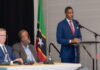
“A facility like this is to guarantee our registered farmers and fisherfolk the support they deserve. There are risks, but we are deliberately working to de-risk agriculture by offering this programme, so our people can have peace of mind, continue to practice their craft, and recover quickly in the event of disaster,” Prime Minister Dr. Terrance Drew told the ceremony.
He said the programme is designed to reduce the risks long faced by those in the agricultural and fisheries sectors, noting that years of investment, often amounting to tens or even hundreds of thousands of dollars, can be wiped out by a single extreme weather event lasting less than 24 hours.
“Imagine investing your time, energy, and finances over five years, only to have it destroyed overnight, with no guarantee of compensation. The psychological trauma, the loss of hope, the financial strain, and the impact on families are real. This programme is about addressing those realities.”
Prime Minister Drew said that REAP goes beyond individual protection, contributing to community stability, economic growth, and national development.
“This initiative is not just about the individual farmer or fisher. It is about strengthening communities, supporting the broader economy, and advancing our vision of a sustainable island state.
“No country can be truly sustainable without food security, and food security must be treated as a central pillar of our national development,” Prime Minister Drew said, noting that the government’s investment in REAP reflects a deliberate effort to elevate agriculture from a secondary activity to a core component of the economy.
“Agriculture must no longer be seen as an afterthought. This is a significant investment, carefully developed over many hours of planning and collaboration. It signals clearly that agriculture is central to our future, and those who work in this sector must be treated with the respect they deserve,” he said.
Prime Minister Drew also outlined the broader economic benefits of strengthening local food production, including reduced food imports, increased employment, and expanded economic activity across related sectors.
He said that when farmers feel secure, they are more likely to invest, increase production, and create additional opportunities, noting that higher output reduces reliance on imports, generates jobs, and supports stronger economic growth, underscoring the importance of the investment.
Prime Minister Drew described REAP as a groundbreaking initiative for the Federation and encouraged farmers and fishers to embrace the programme fully.
The government said that the REAP project is a transformative initiative designed to protect farmers and fisherfolk, strengthen the agricultural sector, and build resilience against climate change. It is being implemented in partnership with Lynch Caribbean Brokers Limited and National Caribbean Insurance (NCI).
Agriculture, Fisheries and Marine Resources Minister, Samal Duggins, said that REAP represents a major step forward in safeguarding the livelihoods of those who feed the country, reiterating the government’s commitment to standing with the Federation’s “food heroes.”
“For decades, we have asked our farmers and fishers to take the risks, to plant, to invest, and to produce. But when disaster came, too many were left to recover on their own. That ends today,” Duggins said, noting that REAP is grounded in a simple but powerful principle: “If you feed this nation, this nation will protect you.
“This protection is not for a select few. It is for all our crops, livestock, and fisherfolk. Food security is not just a slogan; it is a matter of national survival. And those who make it possible are not just workers, they are our heroes,” he said.
Duggins said that REAP introduces a modern, parametric insurance model tailored to the realities of St. Kitts and Nevis and the wider Caribbean. He said the system uses real-time data, satellite monitoring, and predefined triggers to activate payouts automatically when adverse conditions such as drought or storms occur.
“In agriculture, timing is everything. If recovery takes months, you lose a season; if it takes too long, you lose a livelihood. REAP is designed to eliminate delays, reduce paperwork, and remove uncertainty. When thresholds are met, payouts are triggered, not in months, but in weeks.”
Duggins said beneficiaries can receive support within 2 to 3 weeks of a triggering event, enabling them to replant, rebuild, and recover quickly.
The government is also making a significant financial commitment to ensure the programme’s success, allocating one million dollars (One EC dollar = 0.37 cents) annually to support participation and accessibility.
“We are not asking our farmers and fishers to carry this burden alone. We are covering premiums, structuring access, and ensuring inclusion. Protection must not be a privilege; it must be a right for all our food heroes,” Duggins said.










 and then
 , describing it as a vital step towards building a sustainable twin-island federation)