




























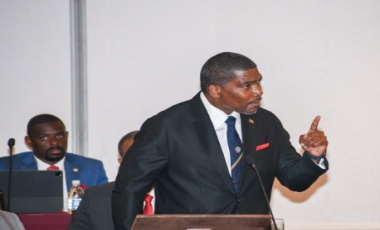
BASSETERRE, St. Kitts, Prime Minister Dr. Terrance Drew Wednesday presented an EC$$1.02 billion (One EC dollar=US$.37) budget to Parliament, saying that the fiscal package will challenge the government, businesses, civil society, and households to rethink their collective approaches to governance, public policy, commerce, socio-economic development and continued existence on both islands.
Drew, who led the St. Kitts-Nevis Labour Party (SKNLP) to office in the August general elections, said that his administration is expecting to raise revenue in line with the projected gross domestic product (GDP) growth rate.
“The Estimates presented here today are therefore forecasting that the fiscal operations of the Government would result in an overall surplus of EC$27.6 million for the 2023 fiscal year and an average of EC$30.7 million over the period 2024 to 2025.”
Drew said that Recurrent Revenue is projected to be approximately EC$993.2 million for 2023 and EC$945.6 million over the medium term, telling legislators that the amount for Recurrent Expenditure would likely reach EC$812.1 million for 2023 with an average annual total of EC$820.6 million for fiscal years 2024 and 2025.
The prime minister said the government would not continue to turn a blind eye to the steady erosion of the tax base as this is not consistent with international best practices in Public Financial Management.
“We understand that there is much room for improvement in the rate of compliance with the various tax legislation. I, therefore, encourage all citizens and residents to be responsible and honor their tax obligations as they become due.
“At the same time, we understand the need for the government to do what we can to continue to support the recovery of our economy. We are also conscious of the need for a comprehensive review of the measures put in place to support businesses and households over the past two years.
“The reality is that as economies across the globe regained growth, many countries have already dialed back their pandemic support. This trend suggests that our government should make similar policy decisions as the economy is demonstrating signs of a rebound in practically all sectors and this trend is expected to follow in 2023,” Prime Minister Drew said.
But he said towards this end. The government will continue to support the reduction of the Corporate Income Tax Rate from 33 to 25 percent for businesses that retain at least 75 percent of their employees and the reduction of the Unincorporated Business Tax Rate to two percent, down from four percent until June 30, 2023.
“This will allow for the time necessary for consultations with key stakeholders in the private sector to help determine the policy direction of the government.
He said the Public Sector Investment Programme would reflect the government’s intention to implement capital projects that will ultimately lead to real economic growth and pave the way for developing a sustainable island state.
“In this regard, we are projecting EC$178.8 million for Capital Expenditure in 2023 while, over the medium-term, outlays are expected to average about EC$165.5 million,” he added.
Prime Minister Drew said that given the significant uncertainties and challenges that confront the global economy, it necessitates the development of realistic policies to minimize the impact of exogenous shocks that may emerge and affect the local population.
He said one aspect of the fiscal policy is to have a predictable and stable revenue base that the twin-island Federation can rely on to fund the various public sector programs.
Drew said the Medium-Term Fiscal Strategy would therefore focus on a number of initiatives, including reducing the heavy reliance on the Citizenship by Investment (CBI) inflows to finance the execution of
The government’s recurrent programs.
In addition, the government will move towards preserving the tax base by limiting discretionary concessions such that the granting of tax concessions would be based on the provisions of relevant legislation governing the tax regime.
It will also continue to strengthen the administration of the tax system, including the review and enforcement of the policies to support taxpayer compliance, as well as assessing and actively pursuing the collection of arrears to government revenue agencies.
Prime Minister Drew is promising to contain and re-prioritize government expenditure as well as design an appropriate framework for the introduction of fiscal rules to guide and strengthen the government’s fiscal operations.
Prime Minister Drew told legislators that the government would be moving to complete the work for the establishment of a Sovereign Wealth Fund, review the Protection of Employment Act, specifically those sections that pertain to severance payments and Long Service Gratuity, to ensure that the
Severance Payment Fund sustainable contributions to the Fund are adequate, and any loopholes in the legislation are closed.
He said the government would also be completing the work necessary to facilitate the introduction of Unemployment Benefits Legislation as well as re-assessing and centralizing the administration of the various social safety net programs to ensure that the programs are sustainable and target those persons who are in need.
Prime Minister Drew, who is also the Finance Minister, said that in 2023, real GDP growth is estimated to be 4.6 percent and 3.9 percent over the medium term.
“The projected GDP growth rate is attributed mainly to the recovery of various economic sectors that were impacted by the prolonged effects of the coronavirus (COVID-19) pandemic. As the economy rebounds, moderate increases in economic activity are projected for the tourism, agriculture, and construction sectors,” he said.
He said the tourism sector, which was most affected by the pandemic, is forecasted to grow by 30.1 percent in 2023 and 5.8 percent, on average, over the medium term.
Prospects for growth for the sector would be contingent on increased tourist arrivals from stay-over visitors and cruise ship calls. Prime Minister Drew said, noting that for the 2022/2023 cruise season, it is expected that over 900,000 passengers would arrive here, and a boost in regional travel is also anticipated.
With respect to the agriculture sector, the government said growth for 2023 is projected to be 7.1 percent and 8.5 percent over the medium term.
“We intend to bring about transformative change to critical sub-sectors of the agriculture sector. To increase food production and reduce our food import bill by 25 percent by 2025, the focus will be on producing local priority crops and products that are highly imported in St. Kitts and Nevis.
“Additionally, greenhouses will be constructed to improve irrigation and pest control. It is expected that these initiatives would increase the sector’s contribution to GDP over the medium-term.”
Prime Minister Drew said construction activity continues to be the largest economic sector and is forecasted to grow by 3.7 percent in 2023 and 2.1 percent over the medium term.
He said the Public Sector infrastructure program will continue in 2023 with the construction and resurfacing of roads in support of the expected increase in housing construction.
“We also intend to advance plans for the design and construction of public buildings, including a new hospital and new Basseterre High School. It is further anticipated that the construction sector will be positively impacted by Private Sector activity through the execution of a number of housing projects.”
Prime Minister Drew said that it was alarming to his new administration the extent to which the financing of the government’s operations had been reliant on the CBI program through which foreign investors are granted citizenship in return for making a substantial investment in the socio-economic development of the Federation.
“This is not sustainable and will not provide a solid foundation for us to build out our vision for a sustainable island state. Over the medium-term, we must therefore chart a different course by reducing the current heavy reliance on CBI inflows to finance the government’s operations.”
Drew said that development partners such as the International Monetary Fund (IMF) have, in the past, raised this as an issue for the government to seriously consider as part of its work to strengthen the policy framework.
“Our vision is for the CBI revenue to be used to finance transformational projects in the Federation. The CBI program would be better utilized to bring about vast improvements in our country’s health and education sectors. It would be better utilized to enhance our public infrastructure, including our roads and electricity and water supplies. “
Drew said the CBI could be of great assistance in the digital transformation of the economy as well as the Federation’s transitioning of the green and blue economies.
“The development of resilient infrastructure would undoubtedly attract further investments to our shores and allow for our people to capitalize on emerging opportunities. It would play a key role in our goals of diversifying the economy and job creation,” he told legislators.







 and then
  budget to Parliament)