














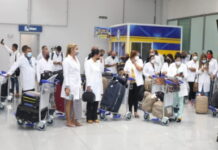

















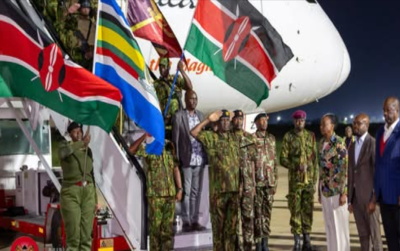
NAIROBI, Kenya, CMC – A contingent of more than 200 Kenyan police officers returned home on Tuesday night from Haiti, where their services formed part of Kenya’s broader leadership role in the UN-backed multinational mission aimed at improving security in the French-speaking Caribbean Community (CARICOM) country.
“215 police officers, who formed the second contingent of the Multinational Security Support (MSS) Mission to Haiti, have safely returned home. The officers were part of our 2023 deployment to support efforts to stabilise Haiti and assist the Haitian National Police in restoring public order in areas affected by insecurity,” the Ministry of the Interior said in a statement.
The officers were met on arrival at Jomo Kenyatta International Airport by Inspector General Douglas Kanja, alongside Interior Principal Secretary Raymond Omollo and other senior security officials.
Their return comes as the MSS undergoes a transition with the first contingent of the Gang Suppression Force (GSF), scheduled to be deployed to Haiti on April 1st, being composed of Chadian troops currently being trained in the United States.
“The deployment will begin on April 1st, and the full GSF deployment will reach 5,500 troops by October 2026,” Dominican Republic Foreign Affairs Minister Roberto Álvarez announced after a briefing on the FRG deployment with the US ambassadors to Haiti and the Dominican Republic.
Under the new arrangement, Kenyan personnel will be withdrawn in phases as the Chadian contingent is gradually introduced.
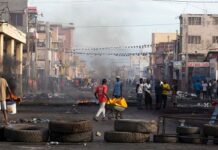
Gang violence has crippled security in Haiti, leading to the displacement of an estimated 1.5 million people, many of whom were already suffering from high levels of poverty – a situation which has been exacerbated by economic collapse.
Haiti’s protracted political transition is not an isolated domestic issue. Still, it has ramifications for regional stability, such as the trafficking of drugs and weapons by gangs and the migration of its citizens overseas.
The UN said the international community has consistently maintained that any durable political solution must be Haitian-led and that the authorities are being supported in their efforts to organise and hold municipal, parliamentary, and presidential elections.
The United Nations Designated Expert on the situation of human rights in Haiti, William O’Neil, said earlier this week that the “ongoing human rights crisis creates massive suffering for the Haitian people, especially the most vulnerable.
“The liberation of territory from gangs and a more ‘motivated and visible’ police presence are offering a glimmer of hope for Haitians amid ongoing violence and insecurity,” he said.
The country also faces political uncertainty, having not had an elected president in office since President Jovenel Moïse was assassinated at his private residence overlooking the capital on July 7, 2021.
Haiti’s Provisional Electoral Council (CEP) said it has registered 320 political parties and organizations for the election and is expected to publish the final list of qualified entities on March 26. It is hoped that elections will be held later this year.
Kenya first deployed its initial contingent of 400 officers to Port-au-Prince on June 25, 2024, in a move regarded as a commitment to restore order in a nation gripped by armed gangs.









 and then