

































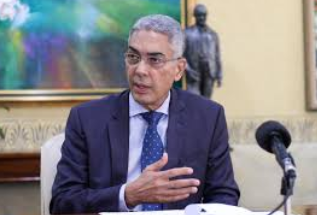
KINGSTON, Jamaica, CMC – Bank of Jamaica (BOJ) Governor Richard Byles has assured that the Bank has sufficient foreign currency reserves to meet demand and help maintain relative stability in the exchange rate.
Byles revealed that on August 12, Jamaica’s gross international reserves stood at US$6.2 billion – a historically high level, representing 148 per cent of the adequacy benchmark.
He acknowledged that the foreign exchange market had experienced “slightly higher-than-usual volatility” in recent months, with the Jamaican dollar depreciating by 2.5 per cent at the end of June compared with December 2024. He attributed this to temporary factors, including uncertainty in the global economy, the dollar crossing the psychological $160 to US$1 threshold, and a narrowing of the gap between domestic and international interest rates.
“This unsteadiness was particularly evident in April and May,” Byles explained, stressing that the BOJ remains committed to a flexible exchange rate regime. He cautioned that, over the long term, if Jamaica’s inflation outpaces that of its trading partners, the public should expect fluctuations around a general trend of depreciation.
The Governor noted that during the June quarter, expectations of depreciation had increased, reflected in higher net open positions by financial institutions and a rise in the dollarisation ratio — the proportion of financial assets held in foreign currency.
Despite these shifts, the BOJ’s participation in the market has been steady. Over the 12 months to July 2025, the Bank sold US$1.2 billion through its Foreign Exchange Intervention Trading Tool (B-FXITT), compared with US$956 million in the previous year, while net purchasing US$931 million over the same period.
Byles added that Jamaica’s balance of payments remains in surplus, supported by robust remittance inflows and continued growth in tourism, even amid global policy shifts. He said these fundamentals, along with BOJ interventions, have helped calm the market: “Since the end of June, the pace of depreciation has slowed and net open positions have declined.”
Meanwhile, the BOJ’s Monetary Policy Committee on August 20 voted to maintain the policy interest rate at 5.75 per cent, reaffirming its commitment to preserving stability in the foreign exchange market.






 and then
  Governor Richard Byles has assured that the Bank has sufficient foreign currency reserves to meet demand)