











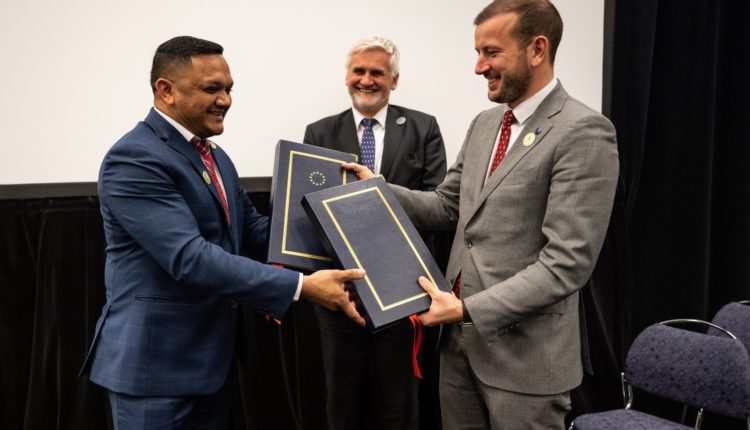
GEORGETOWN, Guyana, Guyana, and the European Union (EU) recently signed a legally-binding trade agreement to promote the sustainable trade of legal timber from Guyana to the European bloc and counter illegal logging in Guyana.
According to a release from the Delegation of the EU to Guyana, the European Commissioner for Environment, Oceans and Fisheries Virginijus Sinkevičius and Guyana’s Minister of Natural Resources Vickram Bharrat inked the agreement at the 15th meeting of the Conference of the Parties to the United Nations Convention on Biological Diversity.
The COP is being hosted in Montreal, Canada.
The Deputy Minister of the Environment of the Czech Republic and Special Envoy of the Czech Government, on behalf of the Czech Presidency of the Council of the EU, Jan Dusík, co-signed the agreement.
The release noted that the agreement would assure EU-based timber buyers that timber products from Guyana are legal. It is also expected to help improve forest governance, tackle illegal logging and promote trade in verified legal timber products.
, The release also noted that Guyana is the first country in the Amazon region to sign the Voluntary Partnership Agreement (VPA) on forest law enforcement, governance, and trade (FLEGT) with the EU.
For the last ten years, the country has been engaging the EU on this VPA.
Through the VPA, Guyana will tackle trade in timber that has been illegally harvested, transported, or processed. The country will improve market access for law-abiding businesses, modernize its forestry sector, create jobs, promote sustainable development, and protect the rights of indigenous peoples.
Under the VPA, Guyana also commits to developing a timber legality assurance system to assess that timber products -for all stages of the supply chain- have been produced by national legislation.
When this system is operational, Guyana can issue verified legal timber products with FLEGT licenses. The license certifies that the timber or timber products exported under that license are legal.
The VPA will ensure this is duly enforced, guaranteeing the sustainable management of the country’s enormous forest area and thus protecting biodiversity. It will also help to improve the competitiveness of Guyana’s timber industry by modernizing timber operations.
This, in turn, will create jobs and ensure that forestry brings employment to the formal economy while expanding trade opportunities as Guyana moves to export guaranteed legal timber products.
Outside of these efforts, however, the EU release acknowledged that Guyana has robust national legislation on forests, including a Forest Code.
“This deal with the EU will boost the trade in legal timber, stimulating the creation of green jobs while protecting our precious environment. This bilateral agreement will advance the integrated planning and management of Guyana’s forest sector under the Low Carbon Development Strategy (LCDS) 2030,” Bharrat said.
Bharrat was keen on pointing out the immense value of Guyana’s forest. He explained that the trees serve as a carbon sink, allowing harmful carbon dioxide to be sucked out of the air.
He also said Guyana has one of the oldest, most diverse, and largest tropical ecosystems worldwide that houses an array of diverse flora and fauna. He added that the forests are home to more than 9 000 species, and we must preserve such wildlife.
Based on the release, too, Sinkevičius said that the VPA is another positive development in fighting illegal logging. The world meets in Montreal to agree on ambitious new targets to halt and reverse biodiversity loss and fight deforestation.
Meanwhile, Dusik said that the agreement contributes significantly to the conservation of Guyana’s forests, which is essential for protecting biodiversity and fighting against climate change.
“Guyana and the European Union already work together very closely, and the Voluntary Partnership Agreement will strengthen our cooperation and stimulate good governance and sustainable forest management,” the Czech Republic Minister said.
With the signing of the deal, Guyana and the EU each need to ratify the VPA according to their respective procedures. Forest stakeholders such as the private sector, indigenous peoples, local communities, and civil society have all been closely involved in negotiating the agreement with the Government and EU representatives. They will continue to play a key role throughout the implementation phase.







 and then
  recently signed a legally-binding trade agreement to promote the sustainable trade of legal timber from Guyana)