




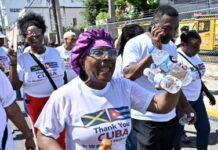

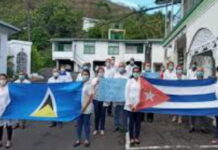










ST. GEORGE’S, Grenada, CMC – The minority opposition Democratic People’s Movement (DPM) has called on Grenadians to show support for Cuba as that Caribbean country continues to feel the impact of United States sanctions that have seriously affected the country’s energy and socio-economic future.
Cuba is experiencing its most severe economic and humanitarian crisis in decades, largely driven by a newly intensified “energy blockade” imposed by the United States. Following the US invasion of Venezuela, resulting in the arrest of President Nicolas Maduro on drug-related charges, Washington has threatened tariffs on any nation supplying oil to Cuba, resulting in a drastic reduction in fuel imports, forcing Cuba to shut down factories, schools, and non-essential state offices.
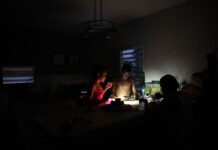
This escalation has led to widespread shortages of fuel, electricity, and other necessities, with the island frequently experiencing nationwide power outages.
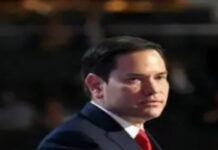
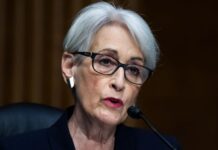
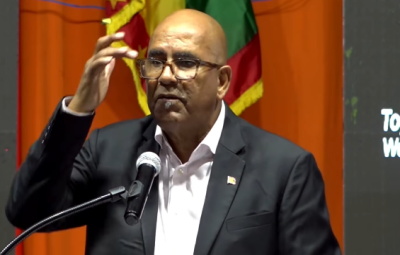
Speaking at the Congress of the DPM on Sunday, the party’s leader and former foreign affairs minister, Peter David, said: “We are told to remain silent in the face of genocide, not to help neighbours who can’t breathe”.
He told supporters that the essence of diplomacy is understanding, compromise, and accommodation.
“But there must be no excuse for surrendering. Not because we are small does it mean that we must cower and bend to every dictate, to every demand. As you know, sisters and brothers, we are at a most treacherous juncture in history.
“The world is now engulfed in discord. War has broken out in many regions, and the global rules-based order has collapsed. What we have always believed in is being tested. We are told to remain silent in the face of genocide, not to help neighbours who can’t breathe, and to adopt ingratitude because somehow that will curry us some favours.”
But David, who is the party’s sole representative in the Grenadian parliament, said Grenadian parents had always spoken out against ingratitude as he welcomed the new Cuban ambassador to Grenada, Yadirys Echenique Paz, to the event.
“I don’t think I’m speaking out of tune if I stand here today and say this nation of ours is grateful. We shall forever be grateful for the bonds and solidarity that have shaped the relations among our people in good times and in bad times. Please convey our gratitude to your government and people. Thank you,” David said.
Cuba played a pivotal role in Grenada during the 1979–1983 revolution, providing significant infrastructural, educational, and military support to Maurice Bishop’s socialist regime, notably building the Point Salines International Airport.
The Grenada revolution came to an end in 1983, when the United States launched a military invasion of the island following the palace coup that had earlier resulted in the deaths of Bishop and several other members of his people’s Revolutionary Government (PRG). Several former PRG members, most notably then deputy leader Bernard Coard, were sentenced to jail for their involvement in the killings.
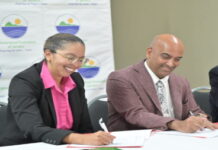
Also addressing the Congress on Sunday was Arley Gill, a lawyer regarded as one of the country’s foremost advocates for reparations, who was elected unopposed as the DPM’s deputy leader.
Gill told supporters, “We continue to stand in solidarity with Cuba.
“Cuba has given us so much, if only now we can stand in solidarity with them and give them and lift our voices in support of the government and people of Cuba,” he added.
Gill, who returned here from the Netherlands, where he had been “advocating in this ongoing struggle for reparative justice,” likened the struggle to what’s unfolding politically in Grenada.
“There is a direct link between the young black boy who went to sleep tonight on the Gold Coast of Africa and the youth hanging out in front of Bucky Shopping Mall. The struggle that I am imploring all of us to embrace, those of my generation and even those immediately after me, is a rite of passage.
“Not defined by the Middle Passage, but coloured by it,” he told supporters, adding that the DPM has always had “my moral support (and) that was never in question”.
But he acknowledged that the “struggle” will take place in different stages, and “I have learnt that you don’t join the movement, you get swept by it, and you become the movement and the movement becomes you”.
Gill, a former government minister who also served as a magistrate in Dominica and Grenada’s ambassador to CARICOM, is expected to contest the western parish of St John’s, considered by some analysts as one of the most open seats if general elections are called soon.
“I believe I have a contribution to make, and I am of the considered view that I can make a difference,” Gill said.






 and then
  has called on Grenadians to show support for Cuba as that Caribbean country)