












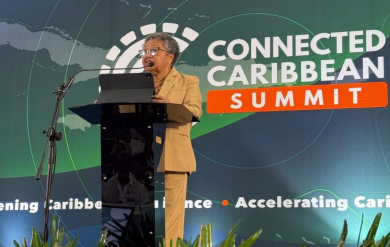
ST. GEORGE’S, Grenada, CMC Caribbean Community (CARICOM) Secretary General, Dr. Carla Barnett, says connectivity remains critical for the region’s development, noting that it is a vital element in the quest to achieve regional integration, economic growth, and social cohesion.
Addressing the five-day “The Connected Caribbean Summit 2025 (CCS 2025),” being held here under the theme “Connecting the Caribbean – How far we have come, how much further to go,” Barnett said that digital networks, air travel, and maritime transport are vital to achieving the goals of the CARICOM Single Market and Economy (CSME).
Barnett said that the key objective of the CSME is to make it possible and easy for CARICOM nationals and businesses to move freely across the 15-member regional integration grouping, fueling economic activity and trade as well as social and cultural engagement.
“To do this effectively, the people of the region need to be able to connect efficiently, conveniently, and cost-effectively. This is required whether we are connecting through digital networks of interconnecting telecommunications systems or through air and sea transportation networks moving people and goods across the Community.”
She said that over the years, much work has been done to address the challenges of inadequate connectedness in the region.
“Conversations on the Single Digital Space, for example, tarried long; as have our discussions on expanded air and sea transportation. We have made progress, but there remains a lot of work to be done.”
She said transportation, whether by air or by sea, is a critical factor in building business and personal relationships by facilitating trade, tourism, and people-to-people exchanges.
“Over the years, especially more recently, we have seen the establishment of additional intra-regional airlines that have expanded links across our region. These efforts have strengthened intraregional mobility, but more can be done. Limited flight options and high operational costs restrict affordable air travel within the area.
“Similarly, developments in maritime links are ongoing, with a focus on improving port infrastructure and shipping services to facilitate the movement of people and goods – especially agricultural commodities – across our region. Plans are being developed to establish ferry services in the southern Caribbean. “
The CARICOM Secretary General said that ongoing efforts are addressing maritime safety and standards, as well as improving port efficiency through various initiatives. But she acknowledged that variable port infrastructure and logistical hurdles affect maritime transport efficiency, affecting trade and mobility.
“Regulatory barriers, varying customs procedures, and requirements still complicate smooth cross-border movement. These challenges underscore the urgent need for strategic investments, policy harmonisation, and sustainable solutions to ensure our transportation networks are resilient and capable of supporting future growth.”
Barnett said that information and communication technology (ICT) is growing in importance as a vital connector of the people of the CARICOM region and that enhanced ICT infrastructure and digital innovations have created opportunities for regional communication, broadcasting, e-commerce, and virtual collaboration, further contributing to connectivity as a cornerstone of the regional development trajectory.
She said the CARICOM region has a relatively high mobile telecommunications penetration, and countries are achieving a notable level of digital skills maturity.
“Guided by important regional strategies, policies and initiatives, such as the Regional Digital Development Strategy, the Single ICT Space and growing integration of ICT into the delivery of services in both the public and private sectors, we are poised to experience an even greater demand for strengthened digital connectivity across our region”.
But she said there are challenges, opportunities, and risks, noting, for example, many questions are being asked about the expanding role of artificial intelligence (AI) “in our lives, the way we work and relate with each other.
“There is a need for much guidance and advice from experts – some of whom are in this room – and much knowledge sharing as we seek to manage these developments,” she said, adding “this means pushing for the deployment of LTE, 5G and cutting-edge technologies as well as ensuring equitable access to connectivity for our most vulnerable and rural communities, and fostering true competition in the digital space”.
Barnett said that while CARICOM has achieved much, the work continues.
“We are faced with challenges that require collective action. Looking ahead, our focus must be sharp, strategic, and unified. There is no progress without challenges. This is as true for connectivity as it is for all areas critical for economic and social development. Prioritising strategic partnerships and targeted investments is necessary to create a robust regional air and sea transport network and to drive digital transformation.
“Our full potential as a region hinges on our continued commitment to be innovative, united, and sustainable. Collaborative partnerships and targeted investments by both the private and the public sectors are the keys that will unlock new opportunities for tourism, trade, and socio-economic development,” Barnett told the delegates.
Since its inception in 2019, the CCS has fostered regional cooperation, evidence-based policy, responsible innovation, and capacity building, delivering practical improvements in governance, economic competitiveness, justice delivery, and social outcomes.






 and then
  Secretary General, Dr. Carla Barnett, says connectivity remains critical for the region’s development, noting)