
























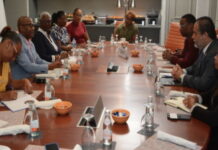
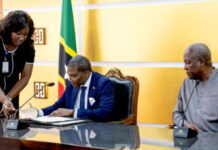



MONTEGO BAY, Jamaica, CMC – Caribbean Community (CARICOM) leaders began their two-day 49th regular meeting on Sunday night, focusing on developments within the 15-member regional grouping, which range from security and external trade negotiations to climate change and food and nutrition.
However, they have also acknowledged that their flagship CARICOM Single Market and Economy (CSME), intended to facilitate the free movement of goods, services, skills, and labour across the Community, continues to fall short of expectations.
CARICOM Secretary General, Dr. Carla Barnett, told the opening ceremony that she is hopeful that the discussions over the next two days will focus on implementing all aspects of the initiative across the region.
“As much as we remain committed to the aims and objectives set out in the revised Treaty of Chaguaramas we must also remain cognizant moving forward is more difficult for some of us,” she said, adding that in the spirit of family “we should seek to address the concerns of all if we are to be a community that benefits everyone in the region”.
Outgoing CARICOM chair and Barbados Prime Minister Mia Mottley recalled that when in 2018 she first addressed regional leaders, she was doing so “as a young, romantic, idealist, and a fervent believer of the regional integration movement.
“Today, I stand to address you with scars and bruising, but still as a young, romantic, idealist. And I am conscious that, over these seven years, our Community has perhaps faced more challenges than we have ever encountered since attaining independence.
“Indeed, some may argue more challenges than we have ever seen since the famous September 1947 Montego Bay Conference, which called for a regional integration movement, such as we have, to be able to allow us to navigate our development journey more effectively. We live in a very different world from 1947, but if ever there was a time for regional solidarity, it is now.”
And Secretary General, I thank you for outlining some of the concerns that we face. When I addressed the heads of government meeting in Barbados a few months ago, I made the point that this was a time for us to lay bare our hearts and to be able to speak frankly, to build the institution that we want.”
Mottley, who has led responsibility for the CSME in the quasi-CARICOM cabinet, said. At the same time, it is true that the actions of the United States government in their promise to impose tariffs on all Chinese-made shipments, nonetheless, “created a catalyst for movement in a way that we could not find on our own”.
She thanked the Caribbean Private Sector Organization (CPSO) for its work with regional governments in addressing the situation.
“The bottom line is, however, that there are still too many gaps. And the major issue of logistics, I am happy to report that there are at least two CARICOM member states that are now in the process of looking to acquire cargo planes to help us overcome the challenging prospect of the movement of goods within this region.”
Mottley said she anticipates that at this meeting, there will be a presentation on the Inter-Island Regional Ferry from the private sector.
“And at this point, it is up to us to determine whether we have the political will,” to move the initiative forward…and that we have allowed ourselves to become purely at the mercy of air travel without recognizing that as islands in the Caribbean Sea, we can reach each other in good time and at cheaper fares than if we only use air to connect our region”.
She said the leaders are also expected to receive the completed work on the CARICOM External Tariff (CET) and the Rules of Origin.
“The political judgment that has to be made by heads now is what other items that will not compromise regional production can have the rate continue to be reduced so that we can see more progress on the reduction of cost of living, particularly of food and sanitary items,” she added.
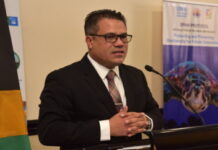
In his address, the host Prime Minister and incoming CARICOM chairman, Andrew Holness, said that since its inception, the CSME has been acknowledged as holding the seeds of great potential.
“Yet many aspects of operationalization continue to elude us, including that of free movement. As the world presses us to strengthen our collective self-sufficiency, we can feel encouraged that 2025 has already marked a turning point with the completion of the signature by participating member states of the Protocol of Enhanced Cooperation.”
Holness stated that this development represents a timely and valuable opportunity to accelerate the efforts of the CSME, and he looked forward to the discussions with regional leaders in this context.
He told the opening ceremony that Jamaica had recently become the eighth country within CARICOM to participate in national consultations on the implementation of CSME initiatives, with the active support of the Guyana-based CARICOM Secretariat.
“These broad-based engagements across the region are designed to deepen stakeholder understanding of the CSME and to showcase the concrete benefits it offers. They represent an important step towards building broader public support and strengthening confidence in the integration process.”
Holness commended the CARICOM Secretariat on its selection and appointment of CSME Youth Ambassadors, who will also be engaged in this process.
“As a CARICOM lead on trade, external trade, and trade negotiations, I will continue to, work with my colleagues to facilitate, reason and balance recommendations on how we can best navigate uncertain dynamics, ensure that our voices are heard in all relevant fora and that our perspectives advance the objectives of a free, transparent, rules-based, inclusive, and equitable multilateral trading system.”
He said that the heads subcommittee for this area convenes again this week and will report back to the summit,” Holness said, adding that the two-day summit will address a wide range of human and social development issues, telecommunications, transport, industrial growth, and demographic shifts.
He said that, alongside these functional priorities, it is clear that key institutional aspects of the regional movement now require renewed focus as regional governments strive to strengthen both internal coordination and external partnerships.
Holness said he remains convinced that youth engagement is necessary in shaping the decisions that affect their future.
“Youth across the region have thoughts and ideas about what we are trying to put in place for them and future generations. As key drivers and consumers of technological advancement, they hold immense potential to contribute meaningfully to our development goals. We must engage them in a deliberate, sustained, and meaningful way.
“Let this meeting send a clear signal that we believe in our youth, we include them in the decision-making process for their future, and that their inclusion is not just symbolic but real,” he added.
He told the opening ceremony that it would be difficult to speak about priorities as a region without acknowledging the broader global context in which the region operates.
“From the humanitarian crisis in Gaza, to the escalating tensions in the Middle East, to the prolonged war in Ukraine, and under-reported conflicts in Africa, each speaks to a more divided and fragile world.
“These realities affect us through energy prices, food insecurity, migration, and more. In this moment, we must be resolute in preserving CARICOM as a zone of peace and reaffirm our commitment to working with the international Community to promote de-escalation of hostilities.
“ We have much ground to cover over the next few days. Hopefully, we’ll cross some of the rivers that I have outlined. But certainly we will prepare the next generation to be able to cross those rivers,” he added.











 and then
  leaders began their two-day 49th regular meeting on Sunday night, focusing on developments within)