



























MONTEGO BAY, Jamaica, CMC – Caribbean Community (CARICOM) leaders on Sunday continued to express their concerns about the deteriorating political, economic, and security situation in Haiti, which is also a member of the 15-member regional integration grouping.
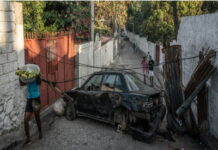
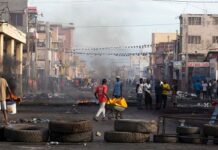
Haiti has been plunged into chaos ever since its president, Jovenel Moise, was assassinated at his private residence overlooking the capital on July 7, 2021. Since then, armed criminal gangs that are controlling almost all of the capital, Port-au-Prince, have sought to overthrow the provisional government.
The United Nations has said that thousands of people, including women and children, have either been killed or forced to flee their homes as the gangs step up their activities to remove the government despite the presence of a Kenya-led Multinational Security Support (MSS) mission.
Barbados Prime Minister Mia Mottley told the opening ceremony that over the last six months, one of the region’s major concerns was the stability of Haiti.
“The world needs a check on itself when it comes to Haiti. If ever we doubted that there were first-class and second-class citizens in the eyes of the world, don’t doubt it anymore.
“In Haiti more people were killed last year in many months of last year than were killed in any other country on earth including those that were at war, and the subject of military conflict and despite that and the promises, The world has been unable to move beyond the promises and the platitudes that would bring help to the people of Haiti.”.
Mottley said that she was not only talking about the loss of life.
“I’m talking about the displacement of citizens from their homes. I’m talking equally about the food insecurity of the people of Haiti. And let us be realistic, our capacity as a Caribbean community has limits, purely because of our size and financial constraints.
“We can help as best we can, as we must. However, the world is also what is needed at this point. Beyond simply deploying troops from Kenya, without the requisite support in terms of the machinery necessary to ensure that those… Kenyan troops and others are not sent like lambs to the slaughter, along with the members of the Haitian police force.”
Mottley said that Haiti is trying as best it can to withstand the assault by gangs, which is to be commended, but at the same time, it is not enough.
“And what is required more than ever is for a truth talk, both within the context of what is possible from Haiti’s perspective, but equally what is possible from the international community.”
The Barbados Prime Minister said that she fears that the absence of that “realistic conversation will continue to mean that ordinary citizens will have their lives put at risk, and if not their lives, their limbs, and if not their lives and limbs, their ability to live as dignified human beings.
“The pace at which progress is needed must be expedited if we are not. To see more and more people suffer,” she added.
Jamaica’s Prime Minister Andrew Holness, who is also the CARICOM chairman, said that the two-day summit here “will also provide another critical platform for dialogue on the situation in Haiti.
“We remain committed to advancing solutions that promote peace, stability and development for our sister nation and by extension the wider community,” Holness said, adding that “Jamaica was one of the first countries to commit that we would support Haiti with security personnel and to raise the call for support for Haiti”.
He supported the statement by the Barbados Prime Minister that “the appetite to support Haiti seemed to have been lost.
“The international momentum in support of Haiti has slowed. We cannot be true to our principles in CARICOM if we do not redouble our efforts in the global community to garner support for the mission in Haiti.
“We cannot leave our brothers and sisters in Haiti at the mercy of gangs. So Haiti and the mobilization of international support for the security efforts in Haiti will be another area of significant effort and priority for CARICOM under my chairmanship,” said Holness, who sought to link the proliferation of gangs in the Caribbean to the ongoing situation in Haiti.
During their meeting here, the regional leaders will hold discussions with the Secretary General of the International Police (INTERPOL), Valdecy Urquiza of Brazil, who assumed the role on November 7, 2024.
Holness said that a July 2024 report by the United Nations Office on Drugs and Crime entitled Caribbean Gangs, Drugs, Firearms and Gang Networks in Jamaica, and Trinidad and Tobago points to a worrying combination of risk factors, including surging drug production in South America, the proliferation and competition of transnational and local gangs, and high availability and use of firearms that have contributed to soaring homicide rates.
He said that if the situation in Haiti is an indicator, “these are not ordinary times, and they require urgent action.
“We must dismantle the influence of gangs in our communities, disrupt their financing, and cut off access to weapons. I am on record as saying that we need to learn from the situation, launch a war on gangs of a similar magnitude and nature to the war on terror.”
Holness said that aside from the climate threat, the threat that is most likely to pose an existential threat in the near term for many Caribbean countries would be the growth of gangs.
“Many Caribbean states, by our history and the kind of civilization which we wish, to develop would seem to categorize gangs as a social problem, a problem caused by alienation of youth, poverty, breakdown in social mores and values, and therefore the policy response, must be or should be a social response, one that treats crime and violence as a public, health crisis.”
Holness said that while this is so, there is no question that it is a social problem why 90 per cent of persons involved in crime are males.
“And speaking for Jamaica, 90 per cent of those who are victims of homicides are males. Yes, there is a strong social component. However, I believe our society and the way we think about crime and violence need to evolve to accept and understand the changing nature of the challenge we face.
“And the truth is that what we are now facing is the organization of violence. It is the organization of violence for profit. It is not merely street level. Dispossessed, socially excluded youngsters.”
Holness said that there is a level of intelligence, a level of resources, a level of organization that has been brought to crime and violence, which is being used to support a profit motive.
He said his view is that policy and jurisprudence need to evolve to address this matter, reiterating that “the situation in Haiti is only an example that we should look at very carefully”.
He said the Security Expo, which forms part of the summit here, “is intended to spotlight our shared commitment to build a safer, more resilient region by exchanging ideas, innovations, and best practices.
“It is also an opportunity for you to see how the significant investments made by the government of Jamaica in national security over the past nine years are yielding results in crime reduction and public safety.
“I just want to say here that the scale and magnitude of the problem, which is being faced by almost all member countries of CARICOM, cannot be addressed overnight. It took 40 years for the problem to emerge to where it is, and short-term measures will not solve it.”
He said it will require significant investment, but it will also require unified public support, “and as we observe the challenges in several of our member states, and we see the rising homicide rates, we also see political dissonance.
“And so it is imperative that we come together as a region so that our publics can see and appreciate that they are not alone in this problem.”
Holness said that the gangs in Jamaica, Lancaster, New York, New York City, New York City, New York, have a connection with gangs in St. Lucia, in Trinidad, in Haiti, in the Bahamas, and that there needs to be joint, coordinated action from the regional level.
“And I believe, from what I have seen and experienced in working with my colleagues, that there is a strong appetite for regional cooperation to address the security matters that are affecting our countries. And as chair, you have my assurance that the matter of security, regionally and in terms of individual countries, that this will be a matter of great priority under my chairmanship,” he told his regional colleagues.










 and then
  leaders on Sunday continued to express their concerns about the deteriorating political, economic)