
























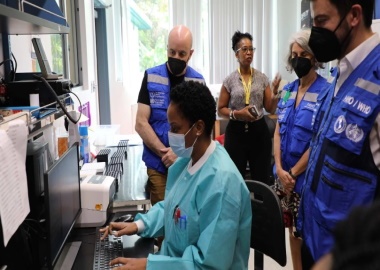
WASHINGTON, The Pan American Health Organization (PAHO) says it has developed a digital platform to bring telehealth services to remote populations in Latin American and Caribbean countries, making telemedicine the “new normal” for healthcare workers and patients managing chronic diseases.
It said that based on Open-Source technology, PAHO’s All-in-ONE Telehealth platform was developed in 2022 thanks to the financial contribution from the United States government and initially piloted in Trinidad and Tobago.
“The platform aims to improve patient outreach and follow-up, with an emphasis on continuity of care for people with non-communicable diseases (NCDs),” said Sebastian Garcia Saison, PAHO’s Director, Department of Evidence and Intelligence for Action in Health.
NCDs are the leading cause of death and disability in the world, accounting for 71 percent of all deaths globally. In the Region of the Americas, 5.5 million deaths are due to NCDs, which include cancers, cardiovascular disease, diabetes, and chronic lung disease.
PAHO said that as they are chronic, they require continuous care and that if left unchecked, worsening conditions can take a significant toll on individuals and their families.
The platform can assist diabetic or hypertensive patients in managing and monitoring their disease. It also allows health workers at remote points to create an “advance triage” to refer patients before they undertake the necessary travel to a health center.
“The health facility where I receive care called me to ask questions. How am I feeling? Do I need medicine? When I’m ready, they have a prescription in my file, and there is no need to travel to the health center. My prescription will be sent to me,” said Sue Ann Peters, a telehealth patient managing a chronic condition in Trinidad and Tobago.
“The installment of the telehealth platform at key referral points will change the lives of patients who in the past had no access to health monitoring when they most needed it,” said Marcelo D’Agostino, Senior Advisor, Information Systems and Digital Health at PAHO.
Training for health technicians and professionals, including in simulation and role-playing exercises, is also a vital component of the platform. This allows authorities to offer health workers diverse learning strategies and to judge best when to use telemedicine or hybrid care, with the patient receiving a combination of telehealth and in-person attention at a local clinic or hospital.
The platform integrates applications such as instant messaging, conversational bots (chatbots), patient medical records, and digital prescriptions. It can also send an alert when a patient’s test results are outside the normal range.
“The All-in-One platform is a vital component of the digital transformation in health in our region, not only in preventing and controlling major NCDs and their risk factors but improving the quality of life of patients with chronic disorders,” said Garcia Saison.
PAHO said the goal in increasing universal access to healthcare is to make the platform available as a public good so that all countries in the region can benefit from it.
“Since the COVID-19 pandemic, both patients and health professionals are more eager now to engage in the use of the benefits of telemedicine,” explained Erica Wheeler, the PAHO representative in Trinidad and Tobago.
This year, a rollout of the All-in-One platform is planned for The Bahamas, El Salvador, Honduras, Peru, Suriname, Dominica, Uruguay, Panama, and Nicaragua.










 and then
  says it has developed a digital platform to bring telehealth services to remote populations in Latin American)