





























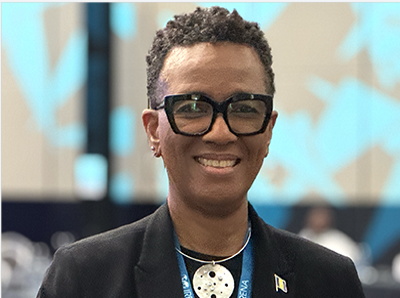
ABU DHABI, United Arab Emirates, CMC – Barbados Saturday told the International Renewable Energy Agency (IRENA) that for small island developing states (SIDS), renewable energy is not only a climate response but also “a developmental imperative, an affordability issue, and an equity issue.
“Our energy transition is about reducing dependence on imported fossil fuels, stabilising electricity prices, and freeing national budgets to better support social and economic development,” the Barbados Ambassador to IRENA, Annalee C. Babb, told the opening ceremony of the 16th session of the IRENA assembly, taking place here through Monday.
The assembly is overshadowed by the United States’ decision to withdraw from IRENA and 65 other international organisations, many of which are UN-affiliated.
Babb, who is also Barbados’ Ambassador to the UAE, said her country had reached a pivotal stage where energy storage is indispensable to unlocking further renewable energy deployment.
“We face multiple hurdles with respect to financing our renewable energy transition,” she told the session that focused on “Pathways for a Renewable Future across Latin America and Caribbean Subregions.
She said that, as a small-island developing state, Barbados needs tailored financing solutions to translate its renewable energy ambitions into a sustainable reality.
“Caribbean SIDS operate small, isolated grids, unlike many Latin American countries with interconnected systems and large hydro resources,” Babb said, adding that high perceived risk results in a higher cost of capital, highlighting the importance of partnerships with multilateral institutions and concessional finance.
“Without access to finance, without access to battery energy storage systems, we will not be able to meet our climate goals,” Babb said, adding that this is true of all SIDS.
“We face structural disadvantages, including small procurement volumes, limited economies of scale, and higher storage costs. In addition, accessing concessional finance is often constrained by onerous application processes and limited human resources.”
The diplomat said Barbados supports differentiated approaches that recognise SIDS’ vulnerabilities and offer simplified, more accessible financing pathways.
She said IRENA, as an energy transition agency, can collaborate with national and regional stakeholders to enhance progress in these areas by providing technical assistance.
“Continued support on energy storage planning, valuation of grid services and stacked-use models,” Babb said, adding that IRENA can also provide technical cooperation on wind resource assessment, turbine selection, and hybrid wind-plus-storage configurations.
She said that IRENA could also mobilise finance and investment by facilitating concessional and blended finance instruments for battery energy storage systems and wind-plus-storage projects.
IRENA says the Latin America and the Caribbean (LAC) subregion has historically been a global leader in clean energy, boasting significant shares of hydropower, wind, and solar generation, which have provided a strong foundation for decarbonisation efforts.
“This abundant resource base presents a massive opportunity for the region to become a global renewable energy powerhouse.”
The recently published “Regional Energy Transition Outlook (RETO) for South America” report, developed by IRENA in collaboration with key regional partners, presents a roadmap for achieving a just, inclusive, and resilient energy transition.
It envisions the region reaching net-zero emissions by the 2050s, in line with the global goal of limiting temperature rise to well below two degrees Celsius.
The report provides a comprehensive, quantitative assessment of pathways to 2050, identifying the technology choices, investment priorities, and policy actions required to accelerate the region’s energy transformation.
The analysis underscores the need for a substantial scale-up of renewables,
significant improvements in energy efficiency and deeper regional power system integration to enhance flexibility and resilience.
Together with IRENA’s earlier work in Central America and on cross-cutting areas such as bioenergy and critical materials, the RETO contributes to a coherent analytical foundation for advancing a more integrated, renewable-based transition across LAC.
Babb suggested that IRENA can advocate with multilateral lenders to simplify and streamline application procedures while maintaining due diligence.
As regards SIDS equity and advocacy, she suggested stronger representation of SIDS-specific challenges in IRENA’s analytical work and global advocacy.
Babb said IRENA could explore a dedicated or preferential procurement window for energy storage for SIDS, recognising small order sizes and long lead times, and provide continued leadership, including through the SIDS Lighthouse Initiative (LHI), to champion equitable access to storage and finance.
The SIDS LHI is a framework for action to support SIDS in their energy transition efforts from fossil fuel dependence to renewables.
The Initiative brings together 41 SIDS and 53 partners, including developed countries, regional and international organisations, development and multilateral agencies, private companies, research institutes, and non-profit organisations. IRENA is the coordinator and facilitator of the Initiative.
Babb told the delegates that Barbados is an island that is 21 miles long and 14 miles wide.
“Our population is 280,000 people. And the challenges we face, I think, are peculiar to many small island developing states, and we need to have solutions that allow us to be a part of this evolution as it continues,” she said.







 and then
  that for small island developing states (SIDS))